







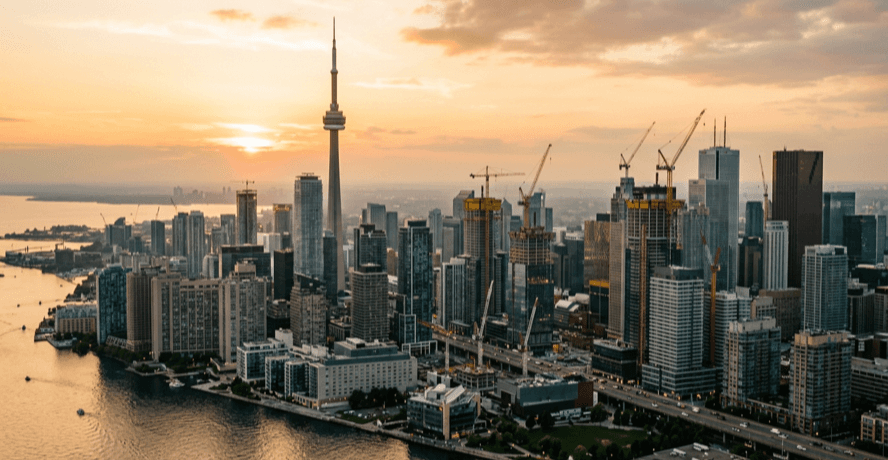
Two skylines are being drawn at once
Stand at Yonge and College this summer and you are looking at the fault line running through Toronto skyline development 2026. On one side, a proposal to raise some of the tallest buildings the city has ever permitted. On the other, a condo market so soft that developers are quietly abandoning towers or rewriting them entirely. Both things are true in the same month, in the same downtown, and the gap between them says a lot about where the city is heading.
The megatowers near College Park
The headline plan sits around 444 Yonge, at the edge of College Park. A cluster of towers designed by Hariri Pontarini has been recommended for approval at 65, 75, and 96 storeys. The tallest would top out near 344 metres, which puts its crown roughly at eye level with the CN Tower observation pod. That is not a figure of speech about ambition. That is a building meant to stand shoulder to shoulder with the landmark that has defined the skyline for half a century.
Getting there is not a formality. The site sits inside the protected view corridors of City Hall and Old City Hall, sightlines the city has guarded for decades so those civic buildings do not disappear behind glass. Building this tall requires an official plan amendment, and that decision heads to City Council at its July 29 to 31 session. A staff recommendation for approval carries weight, but council can still attach conditions, trim heights, or send planners back to the table.
If it passes, the symbolism is hard to miss. Toronto would be signalling that even its most protected sightlines are negotiable when the density math is right. If it stalls, it becomes a marker for how far the city is willing to let private towers reshape the civic core.
The slump rewriting everyone else's plans
Here is the part that complicates the megatower story. While one project reaches for record height, much of the market is going the other direction. The condo slump that set in through 2024 and 2025 has not lifted, and the numbers are starting to show up in the ground, or rather in the towers that never break it.
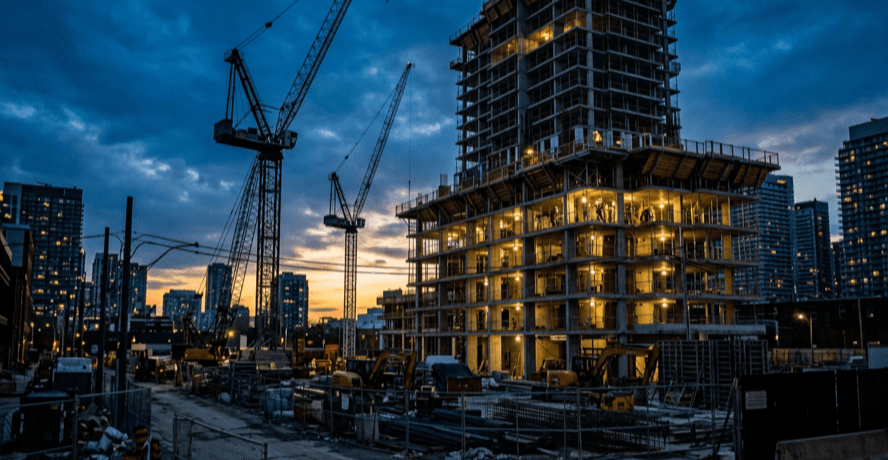
Since the start of 2024, at least 21 condo projects across Toronto and Hamilton have been cancelled. Nine of those did not vanish so much as change costume. They were converted into purpose-built rentals, buildings designed to be held and leased rather than sold unit by unit to investors and end users. The most visible example is in Liberty Village, where a stalled condo proposal came back to life as a 51-storey rental tower. Same site, same crane eventually, very different business model.
That pivot is a rational response to the moment. Presale condo demand has thinned as investors do the math on carrying costs, while rental demand across the city stays high. If you cannot sell units at the price you underwrote, leasing them becomes the way to make a project pencil out. Analysts tracking the pipeline expect the next wave of new buildings to be shorter and smaller, scaled to what the rental math actually supports rather than what a booming presale market once promised.
What it means for the city
Read together, the two stories point to a skyline that is bifurcating. A small number of trophy sites, backed by patient capital and prime locations, will keep chasing height and headlines. The College Park cluster is the clearest current example. Everything below that tier is being disciplined by the rental math, which favours efficiency over spectacle.
For renters, the conversion trend is arguably good news. Purpose-built rental stock is exactly what a supply-starved market has been missing, and buildings designed to be leased tend to stay in the rental pool rather than churning through the resale market. Toronto Digest has covered how the downturn has shifted leverage across the market, including landlords offering free rent to fill units. A wave of new rental towers would deepen that shift, at least in the buildings that actually get built.
For the look of the city, the effect is subtler. Fewer, shorter towers and more rentals means the skyline may grow less dramatically than the boom years suggested, even as a handful of megatowers punch higher than anything before them. The average new building gets quieter while the exceptions get louder.
The read for the rest of 2026
The July council vote is the near-term signal worth watching. Approval near the CN Tower's height would tell developers the ceiling on Toronto ambition just moved. But the more durable story is the quieter one, playing out across dozens of sites where condos become rentals and heights come down to meet the market. For anyone tracking Toronto business and development, that rebalancing is the trend with staying power. The megatowers make the news. The rental pivot makes the city. Keep an eye on both through our ongoing business coverage as the pipeline resets.

















Recommended for you
Breaking Down the Elements of a Masterpiece Painting
The Revival of Classical Art in a Digital Age
Must-See Art Exhibitions Around the World This Year
The Revival of Classical Art in a Digital Age