







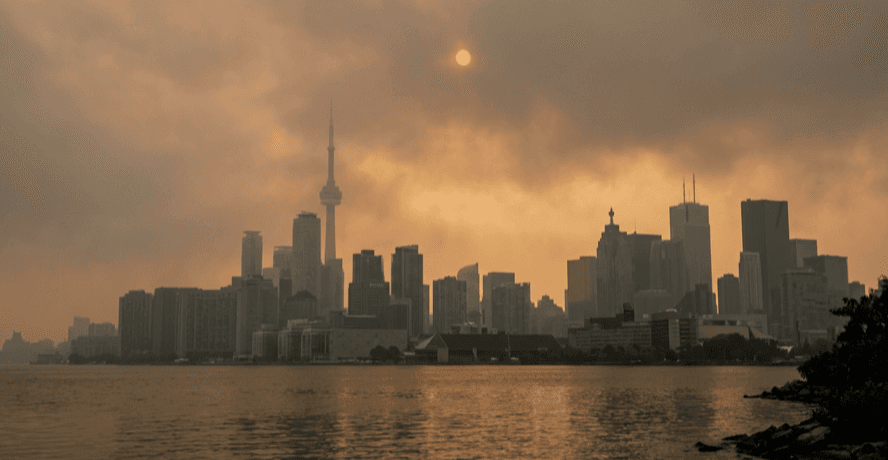
The week the sky went orange
If you stepped outside in Toronto around July 15 and caught that flat, metallic smell in the air, you were breathing the same thing the rest of the GTA was. A thick smoky haze settled over the region, the sun turned a dull orange behind it, and the horizon disappeared into grey. This was not fog and it was not ordinary summer humidity. It was wildfire smoke, carried south from fires burning hundreds of kilometres away.
Environment Canada's Air Quality Health Index climbed to its top rung during the worst of it, hitting 10 or above, the reading it labels "Very High" risk. At times this week, Toronto ranked among the worst major cities in the world for air quality. For a city that usually sits comfortably in the low-risk range, that is a jarring place to land.
What the Air Quality Health Index actually measures
The Air Quality Health Index, or AQHI, is the number worth learning if you plan to live through more of these summers, and you will. It runs on a scale from 1 to 10, with a "10+" category for the extreme days like this one. The index bundles together the pollutants that do the most damage to your lungs and heart, with fine particulate matter (the microscopic soot in wildfire smoke) doing most of the heavy lifting on smoke days.
Here is the practical translation:
- 1 to 3 is Low risk. Go about your day.
- 4 to 6 is Moderate. Most people are fine, but if you are sensitive and you feel it, ease off.
- 7 to 10 is High. Consider rescheduling strenuous outdoor activity.
- 10+ is Very High, which is where Toronto sat this week. The guidance is simple. Reduce or reschedule outdoor exertion for everyone, not just the vulnerable.
The number is not a mood ring. It maps to real health outcomes, which is why it drives real decisions across the city.
Who is most at risk
Healthy adults will mostly feel smoke as scratchy throats, stinging eyes, and a cough that lingers. Uncomfortable, but not dangerous for most. The people who need to take a 10+ day seriously are more specific.
- Anyone with asthma, COPD, or another respiratory condition.
- People with heart disease, since fine particulate stresses the cardiovascular system.
- Young children and older adults, whose lungs are either still developing or more vulnerable.
- Pregnant people, and anyone who works long shifts outdoors.
The strain is not hypothetical. Two Toronto emergency departments reported a jump in respiratory and air-quality-related visits during the worst stretch this week, according to local reporting. When the index spikes, hospitals feel it within a day or two.
How to stay safe when the index spikes
None of this requires panic. It requires a few habits that become second nature once you have lived through a smoke season or two.
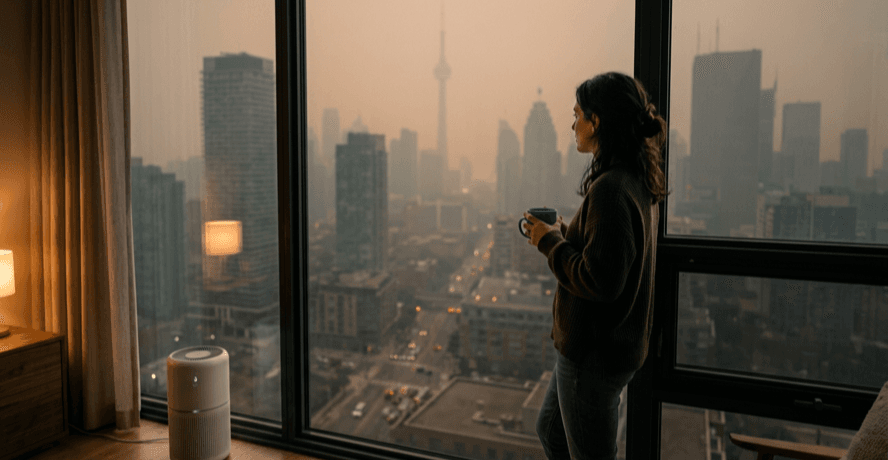
Keep windows closed when the index is high and run the air conditioning on recirculate so you are not pulling smoke indoors. If you have a portable air purifier with a HEPA filter, this is the week it earns its keep. Put it in the room where you sleep.
Move your workout inside. This is also the week to lean into indoor things to do around the city rather than the ravine run or the patio afternoon. Museums, galleries, and shopping centres all filter their air, and they beat sucking down particulate on a jog.
If you have to be outside for a stretch, a well-fitted N95 mask genuinely helps, in a way a cloth or surgical mask does not. And watch your own signals. Shortness of breath, chest tightness, or a cough that will not settle are reasons to get indoors and, if it is serious, to seek care.
The city moved on the same logic this week. Toronto closed some pools and paused outdoor programs, and the Argonauts moved practice indoors. When a professional football team reads the index and heads inside, that is a fair benchmark for the rest of us.
Why smoke season keeps coming back
The uncomfortable part is that this is not a freak event anymore. More than 850 wildfires were burning across Canada during this week's haze, many of them in Northern Ontario, and the smoke does not respect the distance between the boreal forest and the CN Tower. A hot, dry summer produces more fire, and the prevailing winds do the rest, funnelling plumes straight down over the Great Lakes and into the GTA.
Toronto now gets at least a handful of smoke days most summers. Treating them as a normal feature of July and August, the way we treat cold snaps in January, is the honest posture. You do not need to fear the season. You need to know how to read it.
The bottom line
This week's haze was expected to ease within days as the winds shifted, which is the usual pattern. Smoke rolls in, the index climbs, the city adjusts, and clear sky returns. The move is to keep the AQHI bookmarked, to know your own risk category, and to have a plan for the 10+ days so they are an inconvenience rather than a health scare. Keep an eye on our news feed for the next update, and when the air turns, you will already know what to do.


















Recommended for you
Breaking Down the Elements of a Masterpiece Painting
The Revival of Classical Art in a Digital Age
Must-See Art Exhibitions Around the World This Year
The Revival of Classical Art in a Digital Age